
Table of Contents
- How Forsyth Got Here: Growth That Outpaced Planning
- The Development Pause: Buying Time, Not Solving the Problem
- School Overcrowding Solutions the District Is Actually Using
- The Funding Picture: SPLOST, ESPLOST, and Their Limits
- What This Means for Families Buying in Forsyth County
- Inter-Agency Coordination: The Missing Piece
- The Forward View: Realistic Expectations for 2027 and Beyond
- Thinking About a Move to Forsyth County?
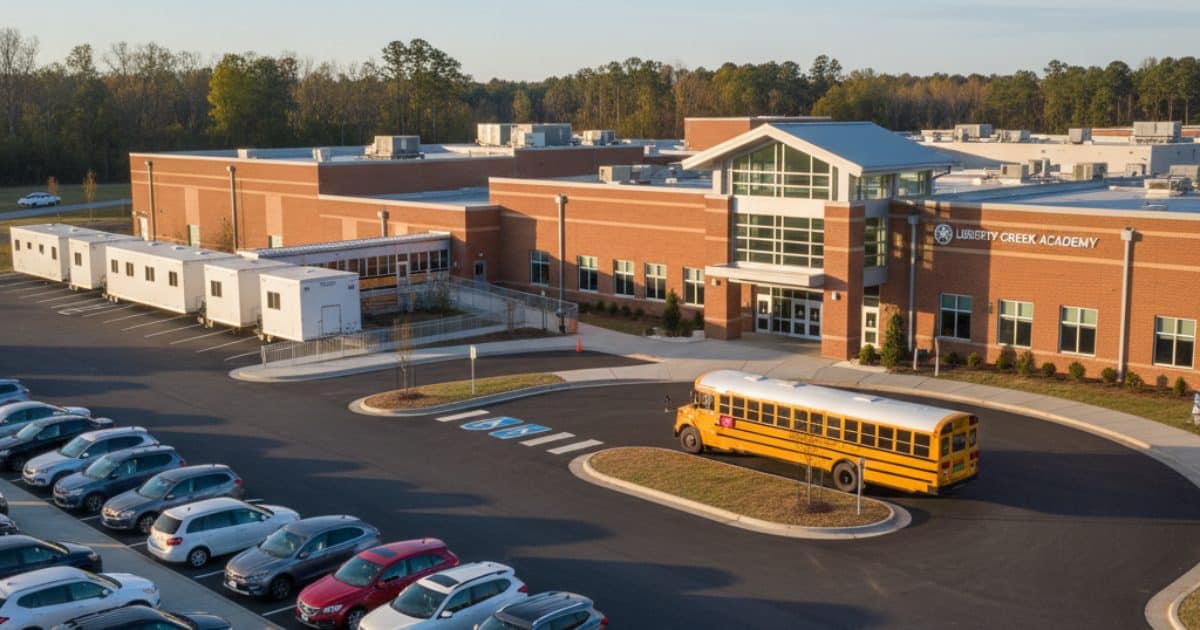
Forsyth County has a problem that most counties would envy and then immediately regret. Families keep moving here, drawn by consistently high school ratings, low crime, and reasonable proximity to Atlanta’s job centers. The result is a school system serving over 54,000 students as of the 2024-2025 school year, with enrollment growing 40 percent over the past decade. As of January 2026, 15 Forsyth County schools are operating over capacity, and some facilities in western Forsyth are running at 110 to 120 percent. The county is no longer in a position to simply build its way out of this. The school overcrowding solutions being deployed now reflect a more deliberate, multi-agency strategy than anything tried before.
How Forsyth Got Here: Growth That Outpaced Planning
Forsyth County’s population sat at roughly 175,000 in 2010. By August 2025, it had crossed 282,000, a gain of more than 60 percent in 15 years. That pace exceeds Gwinnett County’s historical growth rate during its own rapid expansion period, which is a sobering comparison for anyone who watched Gwinnett’s school system strain under similar pressure.
The math is straightforward. More households mean more school-age children. Higher-density residential development, particularly townhome communities and apartment complexes, concentrates those children in specific attendance zones rather than distributing them evenly across the district. According to a panel discussion among Forsyth County officials in August 2026, rezoning applications converting agricultural land to residential use dropped 43 percent since 2022, and proposed density declined from 1.23 units per acre in 2022 to 1.03 units per acre in 2025. Those figures reflect deliberate policy pressure, not a slowdown in demand.
Research from EBSCO’s educational research overview on school overcrowding identifies the core causes consistently: population growth concentrated in suburban corridors, insufficient capital investment lagging behind enrollment curves, and zoning decisions made without adequate school capacity analysis. Forsyth fits that profile precisely.
The Development Pause: Buying Time, Not Solving the Problem
In April 2026, Forsyth County extended its pause on certain high-density residential developments, specifically townhomes, subdivisions, and apartment complexes. The stated rationale was direct: school overcrowding and the need for water, sewer, and road infrastructure to catch up with existing growth. This was not a permanent moratorium, but it was a meaningful signal that zoning decisions would now carry explicit school capacity consequences.
The pause is a short-term tool. It slows the inflow of new students into already-strained attendance zones, giving the district time to execute longer-term school overcrowding solutions. It does not reduce current enrollment, build new classrooms, or address the 15 schools already over capacity.
What it does accomplish is create a policy linkage that had been largely absent. For years, residential development approvals and school capacity planning operated on parallel tracks that rarely intersected formally. The April 2026 extension signals that those tracks are converging, at least for now.
School Overcrowding Solutions the District Is Actually Using
Out-of-District Enrollment Restrictions
One of the most immediate school overcrowding solutions the district has implemented is restricting out-of-district (OOD) enrollment at schools projected to be at or over capacity for the 2026-2027 school year. The Forsyth County Schools Out-of-District policy specifies that schools at or near capacity will not approve new OOD requests. Schools that have been redistricted to relieve overcrowding will not accept OOD students for three years from the start of the school year when new attendance lines were established, with limited exceptions for specific high school program needs.
This policy has direct implications for families relocating to Forsyth County who assume they can request placement at a school outside their assigned zone. In a crowded district, that flexibility disappears quickly. Buyers researching specific neighborhoods should verify attendance zone assignments before committing to a purchase, not after.
Redistricting
Redistricting is politically uncomfortable and logistically complex, but it remains one of the few tools that can rebalance enrollment without building new facilities. When a school in western Forsyth reaches 120 percent capacity while a school two zones over sits at 85 percent, redrawing attendance boundaries is a rational response.
The three-year OOD freeze that follows redistricting is designed to protect the rebalancing effort. If families can immediately opt back into the overcrowded school through OOD requests, the redistricting accomplishes nothing. The freeze enforces stability while enrollment settles into the new configuration.
ESPLOST Capital Investment
The Education Special Purpose Local Option Sales Tax (ESPLOST) is Forsyth County’s primary funding mechanism for school construction and expansion. It is a voter-approved one-penny sales tax dedicated exclusively to capital improvements: new school buildings, classroom additions, technology upgrades, and bus purchases. ESPLOST funds cannot be used for salaries or daily operating expenses, which keeps the revenue stream focused on infrastructure.
Forsyth County voters have consistently approved ESPLOST referendums, recognizing that the alternative is either overcrowded schools or property tax increases. The district’s upcoming ESPLOST cycle is expected to fund new school construction aimed directly at enrollment growth. Without this mechanism, the gap between student population and physical capacity would be substantially wider than it already is.
Strategic Planning and Enrollment Forecasting
Forsyth County Schools operates under a Strategic Plan covering 2022 through 2027. Part of that plan involves working with regional data sources, including Atlanta Regional Commission population and employment forecasts, to project where enrollment growth will concentrate geographically. That forecasting informs decisions about where to site new schools and which existing facilities need expansion priority.
The challenge is that enrollment forecasts are only as accurate as the underlying population projections. When growth accelerates faster than the models anticipated, as happened in Forsyth over the past five years, the district ends up in reactive mode regardless of how thorough the planning was.
The Funding Picture: SPLOST, ESPLOST, and Their Limits
In November 2024, Forsyth County voters approved SPLOST IX, the ninth Special Purpose Local Option Sales Tax referendum. That measure is projected to generate $354,131,400 through 2031, with funds directed toward transportation infrastructure: sidewalks, intersection improvements, and road capacity. SPLOST IX does not fund school construction directly, but it addresses the broader infrastructure strain that population growth creates.
The core tension in Forsyth County is this: the school system’s reputation drives the residential demand that is now threatening the school system’s quality. Managing that cycle requires coordinated action across agencies, not just individual district decisions.
ESPLOST and SPLOST together represent significant public investment, but neither fund is a blank check. ESPLOST is capped by what voters approve and what a one-penny sales tax can generate in a given period. SPLOST covers transportation, not classrooms. The district must prioritize carefully, because the list of needed capital projects exceeds available funding in most planning cycles.
Georgia’s legislative framework also matters here. Discussions at the state level about school impact fees, which would charge residential developers a fee tied to the anticipated school enrollment their projects generate, have surfaced periodically. If the Georgia General Assembly were to allow local governments to implement such fees, Forsyth County would have an additional tool to align development costs with school capacity consequences. As of this writing, that option remains a legislative conversation rather than an implemented policy.
What This Means for Families Buying in Forsyth County
School quality is the primary reason many families choose Forsyth County over neighboring areas. That dynamic has not changed. What has changed is that the district’s capacity constraints now affect specific decisions buyers make, sometimes in ways they do not anticipate until after they are under contract.
A few practical realities worth knowing before you start your search:
- Attendance zone boundaries can shift through redistricting. A school assignment that is accurate today may not reflect where your child will attend in two years.
- Out-of-district requests at overcrowded schools are not being approved. If a specific school is the reason you are targeting a particular neighborhood, verify that the home falls within that school’s attendance zone.
- Western Forsyth, particularly areas near Poole’s Mill and Matt Elementary, is where capacity pressure is most acute as of 2026. Newer development in those corridors continues to add enrollment pressure even as the county works on solutions.
- New school construction funded by ESPLOST will eventually add capacity, but construction timelines are typically three to five years from funding approval to opening day.
None of this means Forsyth County schools are declining. The district’s performance metrics remain strong. But buyers who assume that strong ratings automatically mean uncrowded classrooms are working with an incomplete picture.
If you are looking at homes for sale in Cumming, GA, attendance zone research should be part of your due diligence alongside the standard inspection and title work. The same applies across the county. I have seen buyers fall in love with a house only to discover the school assignment does not match what they assumed based on proximity to a particular campus.
Inter-Agency Coordination: The Missing Piece
School overcrowding solutions that rely solely on the school district are incomplete by design. The district controls curriculum, staffing, and facility use. It does not control residential development approvals, road capacity, or water and sewer infrastructure. Those decisions belong to county government, and historically the two bodies have operated with limited formal coordination on growth management.
The August 2026 panel discussion involving Forsyth County officials was notable precisely because it acknowledged that gap directly. Residential zoning decisions have clear consequences for school capacity, and those consequences need to be part of the approval conversation, not an afterthought. Whether that acknowledgment translates into a formal joint planning process remains to be seen.
The most durable school overcrowding solutions will require the school board and county commission to align their planning cycles. That means sharing enrollment projections with the planning department before developments are approved, not after they are built and occupied. It also means the county needs to factor school capacity into its growth management framework with the same weight it gives to road and utility infrastructure.
The Forward View: Realistic Expectations for 2027 and Beyond
Forsyth County is not going to stop growing. Its location, tax structure, and school reputation are too strong a combination to expect a meaningful slowdown in residential demand. The development pause buys time; it does not reverse the underlying drivers.
Realistic school overcrowding solutions for the next three to five years will likely involve a combination of the following:
- New elementary school construction in high-growth western corridors, funded through the next ESPLOST cycle
- Continued redistricting as new facilities come online and enrollment patterns shift
- Sustained limits on out-of-district enrollment at capacity-constrained schools
- Potential legislative action on school impact fees, if the Georgia General Assembly moves forward
- Ongoing density restrictions on new residential development until infrastructure capacity catches up
None of these are fast. School construction alone takes years from bond approval to ribbon cutting. Redistricting generates community opposition that slows implementation. Legislative changes require sustained advocacy over multiple sessions. The families sitting in overcrowded classrooms right now are not going to see relief from a groundbreaking ceremony.
That said, Forsyth County has the financial tools, the voter support for ESPLOST, and now the political will to link development decisions to school capacity. That combination is more than most fast-growing counties manage to assemble. The district’s track record of passing school funding referendums suggests the community understands the connection between investment and quality.
Thinking About a Move to Forsyth County?
I have lived in Forsyth County for over 16 years and worked this market as a REALTOR® for more than 15. School district questions come up in nearly every buyer conversation I have, and the nuances around attendance zones, redistricting timelines, and OOD policies are not things most people can sort out from a listing description.
If you are evaluating neighborhoods with school assignments in mind, the North Atlanta communities page is a good starting point for understanding how different areas compare. For a broader look at what is available across the county, the Cumming, GA homes for sale search gives you a current picture of active inventory.
The school overcrowding situation in Forsyth County is real, but it is also being addressed through a more coordinated set of school overcrowding solutions than the county has deployed before. For buyers who do their homework on attendance zones and stay current on redistricting decisions, the district’s strengths still outweigh the capacity challenges. That calculus may shift if growth management efforts stall, but for now, Forsyth County remains one of the most sought-after school districts in metro Atlanta for good reason.
If you have specific questions about how school assignments might affect a home you are considering, reach out directly at sellwithsapp.com/contact. I can walk you through the current attendance zone picture for any address in the county before you make an offer.
Frequently Asked Questions
What is causing Forsyth County schools to be overcrowded?
Forsyth County schools are overcrowded due to rapid population growth that has outpaced planning and infrastructure development. The county's population has increased significantly, leading to more school-age children, especially with higher-density residential developments concentrating students in specific zones.
What is the purpose of the development pause in Forsyth County?
The development pause, particularly on high-density residential projects, is a short-term measure to buy time for infrastructure like water, sewer, and roads to catch up with existing growth. It aims to slow the inflow of new students into already strained areas, giving the district a chance to implement longer-term solutions.
How does the district handle out-of-district enrollment requests?
The district is restricting out-of-district enrollment at schools projected to be at or over capacity for the upcoming school year. New out-of-district requests will not be approved for schools at or near capacity, and schools that have been redistricted will not accept out-of-district students for three years.
What is ESPLOST and how does it help with overcrowding?
ESPLOST, or Education Special Purpose Local Option Sales Tax, is a voter-approved one-penny sales tax dedicated to capital improvements for schools. This funding mechanism is crucial for Forsyth County's strategy, as it finances new school construction and classroom additions needed to accommodate enrollment growth.
What should families consider when buying a home in Forsyth County due to school capacity issues?
Families should verify current attendance zone assignments before purchasing a home, as boundaries can shift due to redistricting. Be aware that out-of-district requests are not being approved at overcrowded schools, and new school construction takes several years to complete, so immediate relief from overcrowding is not guaranteed.