Table of Contents
- Why Forsyth County Keeps Attracting Mixed-Use Investment
- The Crossing at Coal Mountain: A New Model for Live Work Play
- The Broader Live Work Play Shift Across Forsyth County
- What Buyers and Investors Should Watch
- Living in Forsyth County Beyond the Development Headlines
- The Design Philosophy Driving the Next Wave
- What This Means for Property Values
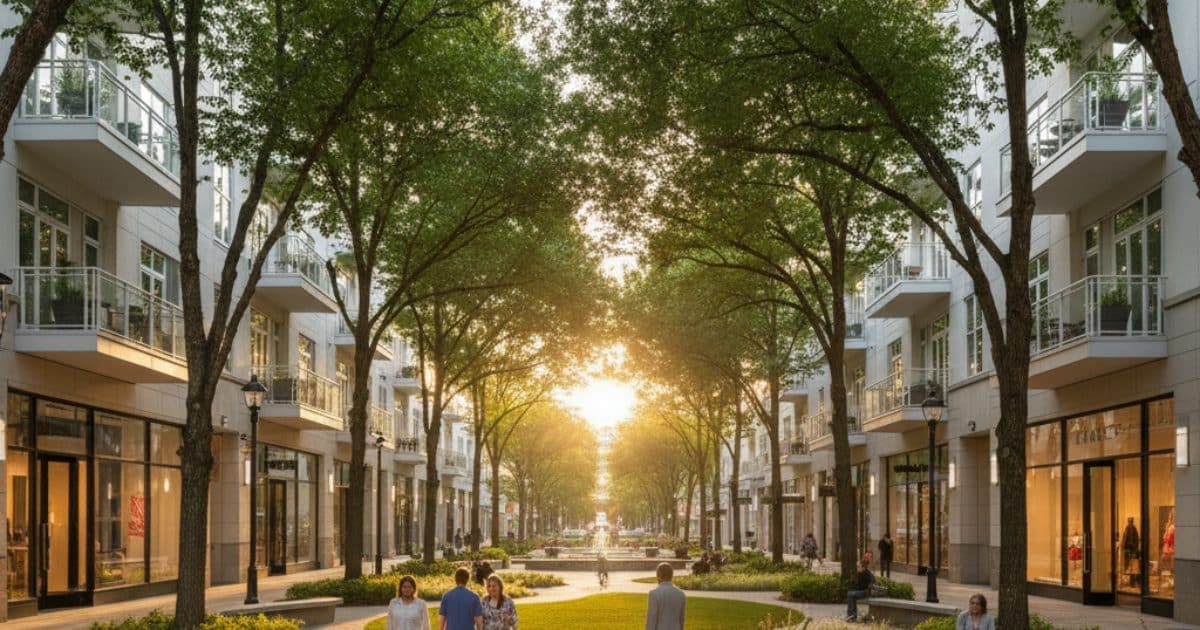
Halcyon put Forsyth County on the map for mixed-use living. The Alpharetta-adjacent development showed what a well-executed live work play environment could look like: restaurants, retail, green space, and residential units layered into a walkable district that felt intentional rather than accidental. It worked. And now developers, planners, and prospective buyers are asking what comes next.
The answer is taking shape across several corridors in Forsyth County, and the projects moving forward are learning from Halcyon’s blueprint while pushing in new directions. Larger acreage, deeper green space integration, and a stronger emphasis on experience over simple proximity are defining this next generation of mixed-use development. If you are evaluating where to buy or invest in North Atlanta, understanding this pipeline matters.
Why Forsyth County Keeps Attracting Mixed-Use Investment
The numbers behind Forsyth County’s growth are not subtle. Between 2010 and 2020, the county’s population grew by 43.2 percent, reaching 244,811 residents. That rate made it Georgia’s fastest-growing large county during that decade. More people means more demand for housing, services, and the kind of amenities that make daily life feel less like a commute-and-collapse routine.
Developers follow rooftops, and Forsyth County has been producing them consistently. As of September 2024, the county had issued 1,446 single-family building permits year-to-date. That figure was lower than the 1,939 permits issued over the same period the prior year, which suggests some moderation in the pace of residential construction. But the underlying demand has not evaporated; it has simply recalibrated.
Commercial development has continued alongside residential growth. Forsyth County recorded 19 commercial building permits year-to-date as of September 2024, reflecting ongoing investment in the retail, office, and mixed-use sectors that serve an expanding population. These are the projects that eventually anchor a live work play district.
Fitch Ratings affirmed Forsyth County’s Issuer Default Rating at ‘AAA’ in August 2024, citing the county’s superior gap-closing capacity, exceptional revenue growth prospects, and moderate long-term liability burden. That rating matters: it signals that the county can fund infrastructure without financial strain, which is a prerequisite for large-scale mixed-use development.
The Crossing at Coal Mountain: A New Model for Live Work Play
The project drawing the most attention in Forsyth County’s next wave is The Crossing at Coal Mountain. At 140 acres, it is a significantly larger canvas than most mixed-use developments in the metro area. Scale alone does not determine quality, but it does allow for design decisions that smaller sites cannot support.
As detailed in a September 2024 analysis by RE Business Online on the evolution of mixed-use development in North Georgia, The Crossing at Coal Mountain is designed around integrated, experience-driven environments rather than simple use adjacency. The distinction matters. Earlier mixed-use projects often placed retail next to residential and called it done. The newer model asks how residents, workers, and visitors actually move through a space and what keeps them there.
What Sets This Project Apart
The Crossing at Coal Mountain is being planned with several features that distinguish it from earlier-generation developments in the region:
- Walkable street grids designed to reduce car dependency within the development itself
- Green space integration woven through the site rather than relegated to a single central park
- Diverse amenity programming that targets daily needs alongside entertainment and dining
- A site footprint large enough to support phased development without sacrificing coherence
That last point is worth dwelling on. Phased development on a 140-acre site can easily produce an incoherent patchwork if the master plan is not disciplined. The stated design philosophy prioritizes connectivity across phases, which is a harder problem to solve than it sounds.
How It Compares to Halcyon
Halcyon succeeded in part because of its location: the boundary between Alpharetta and Forsyth County gave it access to two strong demographic markets. Its scale is more modest, and its retail and restaurant mix is curated toward a specific lifestyle bracket. That focus works well for what it is.
The Crossing at Coal Mountain is positioned differently. Its Coal Mountain location places it deeper into Forsyth County’s growth corridor, closer to the communities forming around the GA-400 and Matt Highway intersection. The target demographic is broader, and the acreage allows for a more varied mix of uses. These are complementary projects, not competing ones.
The Broader Live Work Play Shift Across Forsyth County
The Crossing at Coal Mountain is the most prominent single project, but the live work play trend in Forsyth County is not concentrated in one location. Several factors are reshaping how development is distributed across the county.
South Forsyth’s Continued Density
The southern end of the county, particularly around Cumming’s downtown core and the areas adjacent to Alpharetta, has seen the most concentrated mixed-use activity. Halcyon sits at that southern edge. The area around downtown Cumming has been undergoing its own slower-burn transformation, with new dining, retail, and civic investment adding texture to what was historically a pass-through corridor.
If you are considering a home in this part of the county, the homes for sale in Cumming, GA range considerably in price, style, and proximity to these emerging districts. Understanding which neighborhoods sit within easy reach of walkable amenities versus which require a drive for everything is a meaningful distinction when you are choosing where to buy.
North Forsyth’s Growing Footprint
North Forsyth has historically been the quieter, more rural end of the county. That is changing. The Coal Mountain area, where The Crossing is planned, represents a deliberate effort to bring mixed-use density to a part of the county that has been primarily residential and agricultural. This is a longer-horizon play; the infrastructure buildout will take years. But buyers who purchase in north Forsyth now are making a bet on that trajectory.
The Forsyth County Department of Planning and Community Development oversees zoning and development approvals for all of these projects. Zoning decisions in north Forsyth over the next few years will largely determine how quickly the live work play concept takes hold there versus remaining concentrated in the south.
What Buyers and Investors Should Watch
If you are evaluating a purchase in Forsyth County with an eye toward live work play access, a few variables deserve close attention.
Proximity to Planned Infrastructure
Mixed-use developments generate traffic. The walkability promise only holds if you live close enough to walk. Buyers who purchase adjacent to a development like The Crossing at Coal Mountain during early phases often see appreciation as the project matures, but they also absorb the construction disruption. That is a real tradeoff, not a hypothetical one.
Road improvements and utility expansions tend to follow large mixed-use approvals, but the timing is rarely predictable. Forsyth County’s ‘AAA’ credit rating means it has the financial capacity to fund supporting infrastructure. Whether that funding gets prioritized for a specific corridor depends on the Board of Commissioners’ budget decisions each cycle.
School District Alignment
Forsyth County Schools is a consistent draw for families relocating to the area. Mixed-use developments do not change school district lines, but they do affect the character of surrounding neighborhoods over time. Buyers with school-age children should verify district assignments for specific addresses rather than assuming that a desirable development zone automatically means a desirable school assignment.
HOA and Community Structure
Many of the residential components within mixed-use developments carry HOA structures that differ from traditional neighborhood HOAs. Shared amenities, commercial adjacency, and maintenance responsibilities for common areas can make these HOA agreements more complex. Reading the documents carefully before committing is not optional.
For buyers interested in established gated and amenity-rich communities in Forsyth County, it is worth reviewing the full range of communities across North Atlanta to understand how different neighborhood structures compare.
Living in Forsyth County Beyond the Development Headlines
Mixed-use projects generate a lot of coverage, but the day-to-day experience of living in Forsyth County is shaped by factors that do not make press releases. Traffic on GA-400 during peak hours. The quality of local parks and greenway trails. The density of grocery options within a reasonable drive. School pickup logistics. These are the details that matter once the novelty of a new development wears off.
Forsyth County has invested in its greenway trail network, which provides a non-automotive transportation option that connects residential areas to commercial nodes in some parts of the county. That infrastructure supports the live work play model in a way that development alone cannot.
For a grounded look at what daily life in this part of North Atlanta actually involves, the guide to living in Cumming, GA covers the practical texture of the community: what locals appreciate, what surprises newcomers, and what the county’s growth trajectory means for residents already here.
The Design Philosophy Driving the Next Wave
One thread connecting the newer mixed-use projects in Forsyth County is a deliberate move away from the “lifestyle center” format that dominated the 2000s and early 2010s. That format placed retail in an open-air arrangement and added some residential units nearby, then called it mixed-use. It was an improvement over the enclosed mall model, but it still prioritized retail traffic over residential livability.
The current generation of live work play development in Forsyth County is asking different questions:
- How does a resident’s daily routine flow through the space, not just a shopper’s?
- Where do people gather informally, not just when there is a programmed event?
- What does the project look like at 10 a.m. on a Tuesday, not just on a Saturday evening?
- How does green space function as connective tissue rather than decoration?
These questions do not have easy answers, and not every project will execute well against them. But the fact that they are being asked at the planning stage represents a meaningful shift in how North Georgia developers are approaching mixed-use design.
What This Means for Property Values
The relationship between mixed-use development and surrounding residential values is not automatic. Proximity to a well-executed live work play district tends to support values over time, particularly as the development matures and its amenities become established. But proximity to a poorly executed or stalled project can have the opposite effect.
Forsyth County’s strong fiscal position reduces the risk of infrastructure abandonment, which is one of the more common failure modes for large mixed-use projects in less financially stable markets. A county with a ‘AAA’ credit rating and sustained population growth is a more reliable environment for long-term appreciation than a county running structural deficits.
That said, individual property selection still matters enormously. A home two streets from a planned development entrance is a different investment than a home half a mile away on the same side of a major road. Local knowledge of traffic patterns, planned road improvements, and phasing timelines is the kind of detail that separates informed purchases from hopeful ones.
Conclusion
Forsyth County’s live work play story did not begin and end with Halcyon. The Crossing at Coal Mountain represents a new chapter: larger in scale, more deliberate in its design philosophy, and positioned to serve a part of the county that has been waiting for this kind of investment. The county’s population growth, fiscal health, and continued permitting activity all point toward sustained development pressure that will keep producing projects like this one.
For buyers and investors, the opportunity is real, but so is the complexity. Timing a purchase relative to a development’s phases, understanding the infrastructure buildout timeline, and selecting a specific address within a broader growth corridor all require the kind of granular local knowledge that does not come from a press release or a listing portal.
I have been working and living in Forsyth County for over 16 years. I have watched Halcyon go from a concept to a fully operating district, and I have tracked the projects now moving through planning and permitting. If you are considering a purchase in Forsyth County and want a clear-eyed read on where the live work play corridor is heading and which specific locations make sense for your situation, reach out directly at sellwithsapp.com/contact. No automated responses, no hand-offs. Just a direct conversation with someone who knows this market from the inside.
Frequently Asked Questions
What is the main trend in new mixed-use developments in Forsyth County?
The main trend is a shift towards larger, more integrated live work play environments that prioritize experience and connectivity. These new projects learn from earlier models like Halcyon but emphasize deeper green space integration and a stronger focus on how people move through and interact with the space daily.
How does The Crossing at Coal Mountain differ from Halcyon?
The Crossing at Coal Mountain is significantly larger at 140 acres, allowing for more diverse uses and a broader target demographic compared to Halcyon's more curated lifestyle focus. While Halcyon is situated on the edge of Alpharetta, The Crossing is deeper within Forsyth County's growth corridor, aiming for a more varied mix of uses across its expansive footprint.
What are the risks for buyers purchasing near a new mixed-use development during its early phases?
Buyers purchasing near a new development during early phases may experience construction disruption and traffic. While property values can appreciate as the project matures, the immediate downside is dealing with the inconvenience of ongoing construction and potential infrastructure limitations until the development is fully established.
How does Forsyth County’s financial health impact new developments?
Forsyth County's 'AAA' credit rating from Fitch Ratings indicates a strong capacity to fund necessary infrastructure without financial strain. This financial stability reduces the risk of development abandonment and provides a more reliable environment for long-term property value appreciation compared to less fiscally sound markets.
Should I assume a new live work play development means better schools?
No, new mixed-use developments do not change existing school district lines. While they can influence the character of surrounding neighborhoods, buyers with school-age children must verify specific school district assignments for any address, as proximity to a desirable development does not guarantee a preferred school assignment.